American Reckoning: The Vietnam War and Our National Identity by Christian G. Appy
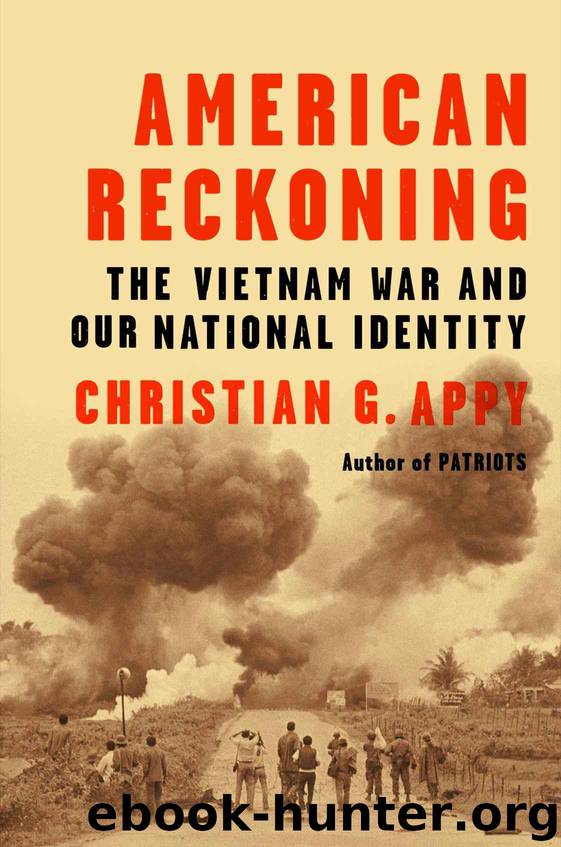
Author:Christian G. Appy
Language: eng
Format: mobi
ISBN: 9780143128342
Publisher: Penguin Books
Published: 2016-01-05T06:00:00+00:00
PART 3
What Have We Become?
8
Victim Nation
BY THE END of 1972, the Vietnam War had been America’s major story for eight years. It was featured on the covers of Time and Newsweek more than a hundred times. A constant stream of headlines, TV reports, speeches, debates, demonstrations, and photographs were daily reminders that the world’s greatest superpower was mired in a war its leaders could not find a way to win, but were unwilling to lose. Then the decade’s biggest story just slipped away. Once the Paris Peace Accords were signed on January 27, 1973, officially marking the end of direct American military involvement, U.S. news organizations closed their Saigon bureaus, leaving a dozen or so journalists to cover a country that had once drawn a media horde of more than five hundred.
President Nixon claimed the Paris Accords achieved “peace with honor.” In fact, South Vietnamese and Communist forces renewed combat almost before the ink was dry. The “standstill cease-fire” proved immediately untenable. The failure of the Accords was easy to predict because fundamental differences were simply papered over. Although the Communist side had agreed to allow the American-backed government in Saigon to stay in place temporarily, it was as committed as ever to the eventual reunification of the country under its authority. And the Saigon regime was still so lacking in popular support it could hardly be expected to survive in the absence of the U.S. military, especially since the Accords allowed North Vietnam to keep 150,000 troops in South Vietnam. With the last 20,000 U.S. troops removed from Vietnam, and hostilities renewed, the collapse of the Saigon regime was virtually inevitable. It was only a question of when. But as soon as the United States was officially at peace, the American media stopped paying attention to Vietnam.
Besides, there was another major story to cover: the slow but steady collapse of the Nixon presidency. As the crimes of Watergate were exposed, drip by drip, the nation was transfixed. On TV, millions of Americans watched the Senate Watergate Committee take hundreds of hours of testimony with tawdry details about White House “bagmen” who paid “hush money,” and “fall guys” who “deep-sixed” evidence, and “plumbers” who plugged “leaks,” all of it creating “a cancer on the presidency.” Eventually the daily spectacle turned to the House Judiciary Committee as it moved inexorably toward a vote to impeach Nixon for abuse of power and obstruction of justice. To avoid a Senate trial and conviction on those charges, Nixon finally resigned on August 9, 1974. Many of Nixon’s early crimes were linked to his effort to attack antiwar critics and keep his war policies secret (and some said the war itself was a crime), but those connections were lost in most of the coverage. During the year and a half that the Watergate drama unfolded, Time ran twenty-eight cover stories on the subject. Watergate 28, Vietnam 0. In the media, at least, the war was forgotten.
But in early 1975, Indochina roared back into the headlines. Communist forces, emboldened by recent victories, had begun their final offensive.
Download
This site does not store any files on its server. We only index and link to content provided by other sites. Please contact the content providers to delete copyright contents if any and email us, we'll remove relevant links or contents immediately.
| Africa | Americas |
| Arctic & Antarctica | Asia |
| Australia & Oceania | Europe |
| Middle East | Russia |
| United States | World |
| Ancient Civilizations | Military |
| Historical Study & Educational Resources |
The Radium Girls by Kate Moore(12095)
100 Deadly Skills by Clint Emerson(4974)
Rise and Kill First by Ronen Bergman(4840)
The Templars by Dan Jones(4739)
The Doomsday Machine by Daniel Ellsberg(4556)
The Rape of Nanking by Iris Chang(4264)
Killing England by Bill O'Reilly(4042)
Stalin by Stephen Kotkin(4007)
Hitler in Los Angeles by Steven J. Ross(3981)
12 Strong by Doug Stanton(3582)
Hitler's Monsters by Eric Kurlander(3386)
The Code Book by Simon Singh(3252)
Blood and Sand by Alex Von Tunzelmann(3241)
Darkest Hour by Anthony McCarten(3161)
The Art of War Visualized by Jessica Hagy(3045)
Hitler's Flying Saucers: A Guide to German Flying Discs of the Second World War by Stevens Henry(2777)
Babylon's Ark by Lawrence Anthony(2721)
Tobruk by Peter Fitzsimons(2559)
The Second World Wars by Victor Davis Hanson(2554)
